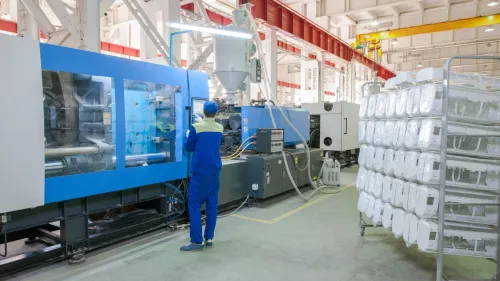
Automation could drive up to 60% efficiency gains in manufacturing support functions
Manufacturers report cost reductions from automation and AI in selected production and support functions.
Manufacturing support functions can deliver up to 60% efficiency gains from robotic process automation, according to a McKinsey & Co. report.
This comes alongside 20% to 30% process efficiency improvements and 25% to 40% reductions in documentation work through automation.
In a report, McKinsey said manufacturers are increasingly using automation, artificial intelligence, and operating model redesign to reduce costs across engineering, maintenance, quality, production management, and supply chain functions.
Value stream mapping and process simplification can generate 10% to 15% improvements in logistics and up to 15% gains in maintenance work order processes.
McKinsey & Co. identified seven improvement levers across manufacturing support functions, including reducing internal demand, redesigning operating models, and shifting work through offshoring and outsourcing.
Other levers include improving process efficiency, enabling work through technology, managing performance and productivity, and developing capabilities and mindsets.
Reducing demand involves cutting non-essential tasks and adjusting internal standards, with up to 10% value creation from optimised quality control plans, 5% to 10% savings from maintenance strategy changes, and 10% improvement from reduced administrative workload in production management.
Operating model redesign shifts work between centralised and decentralised structures, including centralised maintenance planning, pooled spare parts management, and central demand planning.
Offshoring and outsourcing are applied where response time and physical presence are less critical, including cases such as external computer numerical control programming.
Process efficiency improvements include reduced handling steps in logistics, layout changes, and streamlined planning for production lines and product launches, with engineering showing 15% to 20% improvements in selected cases.
Technology enables automation of data handling, maintenance planning, production scheduling, and logistics operations, with automated guided vehicles supporting material movement in production and warehouse environments.
Performance management applies productivity tracking to support functions such as laboratory operations, inbound quality inspection, and warranty processing, delivering 15% to 20% gains. Capability development focuses on skills matrices, structured training, and coaching systems for operational roles.
Companies typically apply three implementation approaches, with zero-based targeting as the first approach, which rebuilds functions from minimum required activities over 12 to 18 months.
The second approach is operating model sprints, which focus on targeted functional redesign using cross-functional teams.
The third approach is field and forum models, which group plants into cohorts to scale implementation across networks.